About CULEST
Background
Contemporary sustainability crises such as global warming, biodiversity loss, and growing inequality, along with the associated social and political polarization, have now been comprehensively described and thoroughly examined by various scientific disciplines. However, much less research has been done on how deeply rooted cultural patterns of interpretation contribute to the emergence (but also the potential solution) of these multiple crises.
Research from the interdisciplinary field of cultural evolution suggests, for example, that ecologically unsustainable modes of production and consumption are closely linked to prevailing, often ecologically harmful, worldviews and narratives. At the same time, sustainability transitions research discusses different roles of change agents, but so far has only provided fragmented and sometimes inconsistent approaches to their change agency.
The state of research on worldviews and narratives is similarly fragmented: their structural power to enable or block sustainability-oriented and potentially transformative change has rarely been systematically analyzed. CULEST addresses this by conceptually bringing together these largely isolated strands of research and empirically investigating if and how “change agents” may shape the cultural evolution of sustainability-relevant worldviews and narratives.
Project Objectives
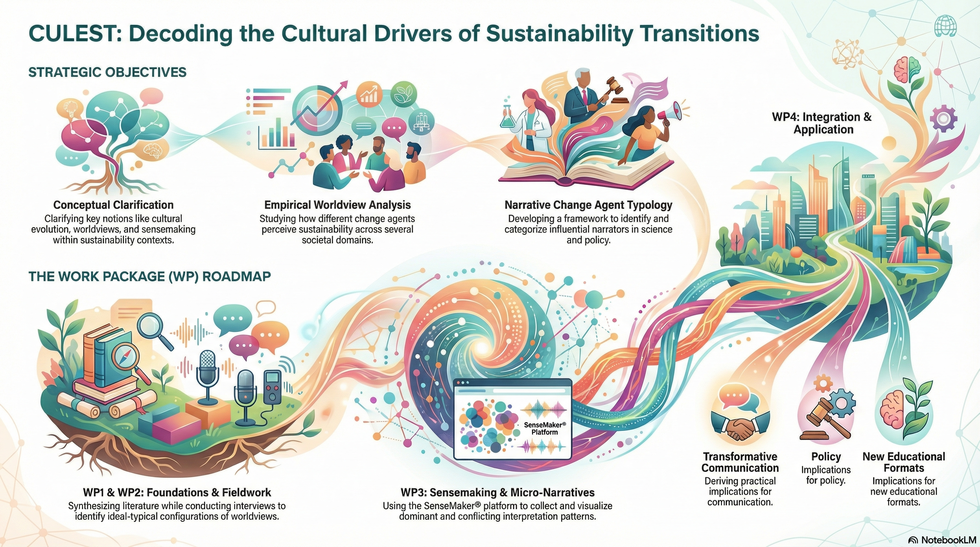
Theoretical and conceptual clarification of key notions (e.g., cultural evolution, worldviews, narratives, sensemaking).
- Empirical study of worldviews and perceptions of sustainability among different groups of change agents across several societal domains.
- Creating an understanding of change agency that acknowledges complexity in the context of narrative patterns and sensemaking processes
- Utilization of the SenseMaker® method for research at the interface of worldviews, sustainability transitions, and cultural evolution.
- Exploring the possibility of developing a typology of “narrative change agents” for science, policy, civil society actors, and education.
WP lead: Michael Schlaile
WP1 develops the theoretical and methodological foundations of the CULEST project. WP1 systematically synthesizes literature and measurement instruments on cultural evolution, worldviews, narratives, and sensemaking in the context of sustainability transformations and transitions. On this basis, an integrative theoretical framework is developed that brings together different strands of research and terminology and sharpens them conceptually. In addition, an overview of key concepts, operationalizations, and methods is developed to serve as a reference for further work packages and subsequent research.
WP lead: Michael Schlaile
WP2 is dedicated to the empirical capture and analysis of worldviews among change agents in selected societal domains, such as social (innovation) movements, religious organizations, politics, and business. To this end, established worldview tests are used and supplemented by semi-structured interviews. The aim is to identify ideal-typical configurations of worldviews and their respective relationship to perceptions of sustainability and to render them comparable.
WP lead: Adrian Wagner (previously: Veronica Hector)
WP3 focuses on the sensemaking processes of change agents. Using the SenseMaker® platform, micro-narratives are collected and self-interpreted by participants along various “signifier” dimensions. The data is then evaluated both quantitatively and qualitatively to reveal dominant, marginalized, and conflicting patterns of interpretation in transformation processes, visualize them in narrative landscapes, and relate them to the worldviews studied in WP2.
WP lead: Michael Schlaile
WP4 integrates the results from WP1 to WP3 to explore the possibilities of developing a differentiated typology of narrative change agents or change agency. In connection with this, implications for transformative communication and policy as well as educational formats shall be derived based on the empirical results.